A car that will not start in a Kannapolis driveway gives you a symptom, not an answer. Clicking, slow cranking, total silence, and lights that die when you turn the key each point in a different direction, and most of those directions lead back to the battery and its connections, especially after a hot summer. Heat degrades battery plates month after month while warm weather hides the loss, because a warm engine is easier to turn. The first demanding start exposes what July and August already did.
This troubleshooting walk starts from what you hear and see, narrows to the likely cause, and marks clearly where driveway checks end and a professional test begins. A mobile visit from Eric's Mobile Mechanic's LLC is built for exactly this situation, but you can learn a lot before anyone arrives.
Start with the sound
A rapid clicking usually means the starter is trying but voltage collapses under load: a discharged or failing battery, or a corroded connection strangling the current. A single solid click with no crank points more toward a starter or a very poor connection. Slow, labored cranking that improves on a second try suggests a weak battery or thick resistance at the terminals. Complete silence with no dash lights suggests a fully discharged battery, a loose main connection, or a failed ignition feed. Write down which one you have. That description saves real diagnostic time.
- Check the obvious loads. Were lights, a door, or an accessory left on overnight? A healthy battery drained once can often be recharged and tested, rather than replaced blindly.
- Inspect the terminals. Look for crusty corrosion and clamps you can wiggle by hand. A loose or corroded clamp can mimic a dead battery exactly.
- Try a jump carefully. If it starts instantly on a jump, the engine and starter are likely fine and the problem is charge: battery, connections, or charging system.
- Watch what happens next. If the car dies shortly after cables are removed, suspect charging. The alternator may not be sustaining the system on its own.
- Note the pattern. Fails only after sitting overnight points to a weak battery or a parasitic drain. Fails only hot points more toward a starter struggling with heat.
- Stop and test. If a jump does not help, or the same failure repeats within days, further cranking only drains what charge remains. Get battery, starter, and charging tested as a set.
Why heat is the hidden cause
Batteries lose capacity with age, and heat accelerates that aging. Fluid loss, plate corrosion, and internal shorts all progress faster in a hot engine bay. Short trips around Kannapolis compound it, because the alternator never gets the sustained run time needed to fully replace what the starter used. Air conditioning, fans, and lights add load on exactly those short trips. By late summer, many batteries are living on a narrowing margin, starting fine at noon and failing at dawn.
Corrosion deserves its own mention. The crust on terminals is not cosmetic. It is resistance, and resistance under starter load becomes heat and voltage drop. A battery that tests acceptable can still fail to start a car through a bad connection, which is why cleaning and tightening are diagnostic steps, not just housekeeping.

The fix-it-yourself boundary
Tightening a loose clamp, cleaning light corrosion with proper protection, and jump-starting correctly are reasonable driveway tasks. Beyond that, the honest answer is testing. A load test measures the battery under demand. A charging test confirms the alternator output. A draw test finds a module that will not sleep. Replacing parts by guess, battery first, then starter, then alternator, is the most expensive troubleshooting method there is, even when each individual part seems plausible at first glance to an owner hoping for a simple and quick answer. One measured test beats three hopeful swaps, and it leaves you with a car that starts in Kannapolis in every season, not just on mild afternoons.
Common questions
Why does my car click but not start?
Rapid clicking usually means voltage collapses under starter load, from a weak battery or a corroded, loose connection. Check the clamps first, then get the battery load-tested.
It started with a jump. Do I still need help?
Yes, if it happens again. A single drain from lights left on may only need a recharge and test. Repeated jumps mean the battery, charging, or a drain needs diagnosis.
Can a battery fail suddenly after a hot summer?
It feels sudden, but the wear was gradual. Heat degraded the battery for months while warm starts hid the loss, until one start asked for more than it had left.
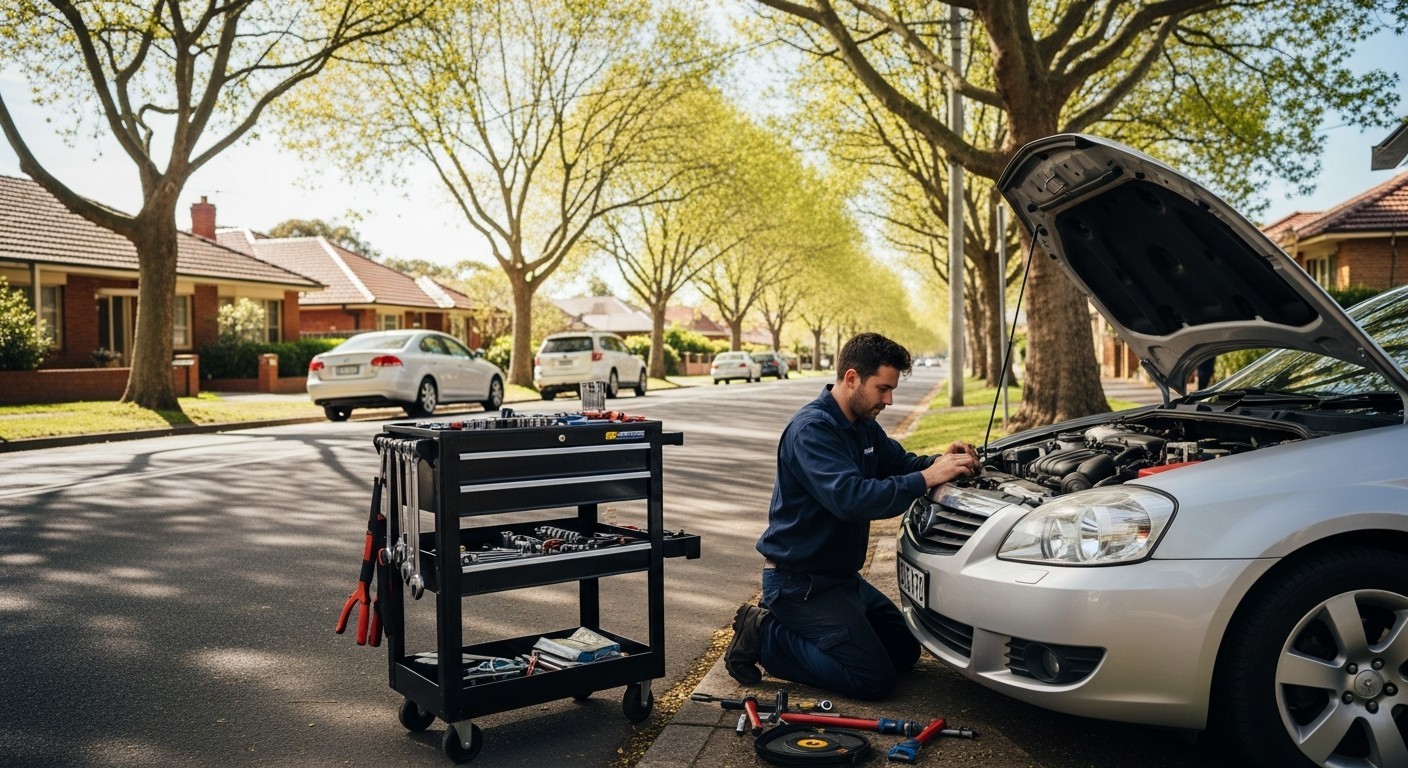
Photos in this guide are representative stock images.
← All guides from Eric's Mobile Mechanic's LLC← Back to Eric's Mobile Mechanic's LLC