Should you replace the timing belt now, wait for the next interval checkpoint, or stop worrying because your engine has a chain? That decision, faced by Kannapolis owners of higher-mileage cars every week, depends on three facts: which system your exact engine uses, whether that engine is an interference design, and what evidence you have about its history. This decision guide lays the options side by side by situation, so the choice follows from your car's facts rather than from fear or optimism.
A timing belt or chain keeps valves and pistons in sync. Belts are rubber, live behind a cover outside the oil, and carry a replacement interval in both miles and years. Chains are metal, live in oil, and are designed to last the life of the engine, with tensioners and guides that can still wear. Interference engines suffer internal damage if timing is lost. Non-interference engines usually just stop.
Choose by situation, not by slogan
| Your situation | Best move | Reasoning |
|---|---|---|
| Belt engine, at or past the manual interval | Replace the belt kit promptly | The interval already accounts for age and wear. Running past it on an interference engine risks major damage. |
| Belt engine, used car, no service record | Budget and schedule replacement | With no proof, assume the belt is original or overdue. Belts give almost no external warning before failure. |
| Belt engine, documented recent service | Monitor and drive | A dated record with pump and tensioners replaced means the system was renewed as a set. Note the next due date. |
| Chain engine, quiet, oil kept on schedule | Monitor and drive | This is the design case. No routine replacement is scheduled. Keep oil clean and listen for changes. |
| Chain engine, cold-start rattle or timing codes | Diagnose soon | Rattle and cam timing faults point to tensioner or guide wear. Early repair is far smaller than post-failure repair. |
| Any engine, oil or coolant leak near timing cover | Inspect promptly | Fluid contamination shortens belt life and signals related wear. On chain engines, leaks threaten oil level, which chains depend on. |

What a belt service should include
When you do choose replacement, choose the complete job. The belt, tensioner, idler pulleys, and usually the water pump share the same labor to access, and the pump is often driven by the belt itself. Replacing only the belt leaves same-age parts behind the cover, any of which can fail and take the new belt with it. Ask for the parts list in writing before approving, and keep the dated record in the car. That record is real value at resale, because the next buyer's decision table starts with whether your service can be proven.
For chain engines, the equivalent discipline is oil. Chains and hydraulic tensioners depend on correct oil, at the correct level, changed on schedule. Stretching oil intervals to save a little is the chain version of skipping a belt: invisible for a long time, then suddenly the whole problem at once.
The mileage question, answered plainly
Owners often ask for a single safe mileage figure that applies to every belt, and no such figure exists. Intervals are set by each manufacturer for each engine, and they pair mileage with years because rubber ages parked as well as driven. A low-mileage car that sat for years can be overdue on time alone, while a highway-driven car reaches the mileage limit with a belt that has lived an easier thermal life but is still at its specified end. That is why the decision table uses your manual's interval for your engine, rather than a number remembered from a different car, a neighbor's experience, or an older model with a different design.
Making the call in Kannapolis
If your situation lands in a replace or diagnose row, do not let a smooth idle talk you out of it. Timing systems characteristically run well until they fail, so present comfort is weak evidence. If your situation lands in a monitor row, write down why: the record you saw, the interval you confirmed, the oil habit you keep. A decision you can state in one sentence is a decision you will not re-litigate at every oil change. Shops like Eric's Mobile Mechanic's LLC can confirm which system your exact engine uses if the manual is unclear, which is the right first step when the table's first column is the one you cannot fill in.
Common questions
My belt looks fine through the inspection gap. Can I wait?
Visual checks miss internal aging, and most of the belt is hidden. The manual interval in miles and years governs, not appearance.
Do chains ever need replacement?
Not on a schedule, but worn tensioners, guides, or a stretched chain from symptoms or codes do need repair. Quiet chain engines with good oil habits are left alone.
Should the water pump be replaced with the belt?
Usually yes when the belt drives it or it sits behind the same cover. The shared labor makes it the economical moment, and a failed pump can ruin a new belt.
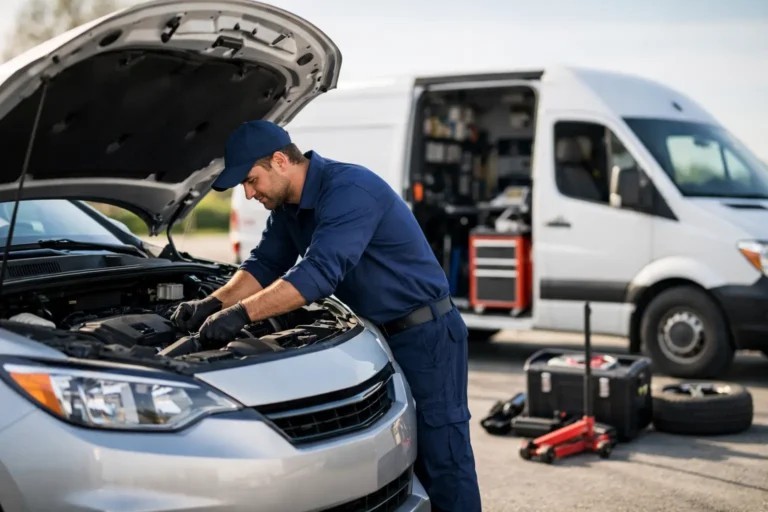
Photos in this guide are representative stock images.
← All guides from Eric's Mobile Mechanic's LLC← Back to Eric's Mobile Mechanic's LLC